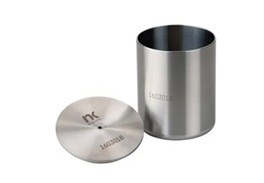
Stainless Steel Pycnometer
NK by NEURTEK pycnometers allow highly accurate measurement of the specific gravity of paints, inks and adhesives, ensuring traceable results in quality control laboratories.
NK by NEURTEK pycnometers are precision instruments designed to determine the specific gravity or density of paints, inks, adhesives, pastes and other industrial liquids. Made from high-quality materials, they provide consistent and repeatable results, essential in quality control laboratories.
What is a pycnometer and what is it used for?
A pycnometer is a small metal container with a perforated lid that allows the specific gravity of a liquid to be measured with great accuracy.
When the container is filled and the lid is closed, excess sample is expelled through the upper hole, ensuring a constant volume and a reliable measurement.
Most common uses of a pycnometer
- Quality control in paints and varnishes.
- Analysis of inks, adhesives and industrial pastes.
- Density and specific gravity testing in laboratories.
How to use a pycnometer step by step
- Weigh the empty pycnometer (if no tare is available).
- Fill it almost completely with the product to be analyzed.
- Place the lid: excess liquid will be expelled through the upper hole.
- Clean the exterior and the lid to avoid residue.
- Weigh it again and subtract the weight of the empty container.
- Calculate the specific gravity using the obtained density.
- Clean the instrument after each use to maintain its accuracy.
Key features of NK by NEURTEK pycnometers
- Materials: Stainless steel or anodized aluminium.
- Capacities: 50 cc and 100 cc.
- Tare option: For balanced and fast measurements.
- Accuracy: Calibrated design that ensures constant volume.
- Maintenance: Easy to clean and long-lasting durability.
Certification and guaranteed traceability
All NK by NEURTEK pycnometers can be supplied with the SER-CT045 Calibration Certificate, which ensures metrological traceability in accordance with international standards. This allows auditable and valid results in certification processes or industrial quality control.
What do you need to complete the measurement?
For a reliable test, the use of a compatible precision balance is recommended. The NEURTEK team can advise you on selecting the ideal model for your laboratory needs.
Frequently asked questions about NK by NEURTEK pycnometers
What are the differences between the 50 cc and 100 cc models?
The capacity varies depending on the type of sample. The 50 cc model is ideal for small samples, while the 100 cc is suitable for higher-volume tests.
What is the difference between “specific gravity” and “density”?
In practice, these terms are very closely related: density is mass per unit volume; specific gravity refers to the mass (or weight) of a sample relative to its volume. In quality control they are often used interchangeably, depending on the laboratory.
How should the sample be properly prepared (temperature, homogeneity)?
The sample must be homogeneous and at a controlled temperature (record the temperature), as density varies with temperature. Stir or filter according to the standardized testing procedure.
References
| Reference | Description | Buy |
|---|---|---|
| NK-DC2000-100 | Pycnometer DC2000 stainless steel density cup 100 cm3 | Request quotation |
| NK-DC2000-100T | Pycnometer DC2000 stainless steel density cup with tare 100 cm3 | Request quotation |
| NK-DC2000-50 | Pycnometer DC2000 stainless steel density cup 50 cm3 | Request quotation |