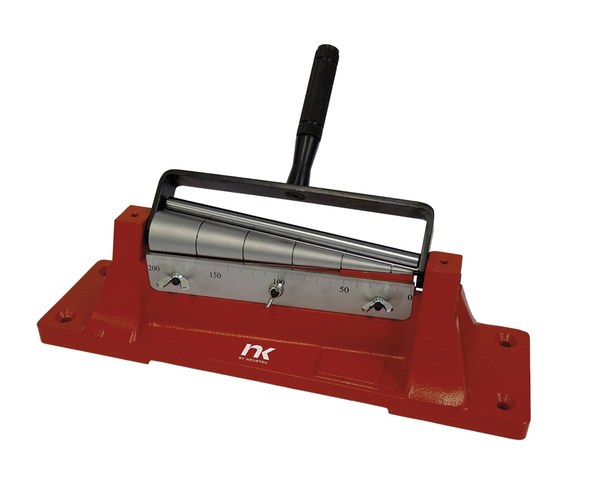
Conical Mandrel Bend Tester
The NK by NEURTEK conical mandrel allows continuous bending tests to measure the flexibility and adhesion of coatings on metal sheets, complying with international standards UNE EN ISO 6860 and ASTM D 522-93a.
What are NK by NEURTEK bending mandrels?
Mandrels, both in conical and cylindrical versions, are designed to carry out bending tests on coatings applied to metals. These tests allow the evaluation of:
- Flexibility of the coating.
- Adhesion to the substrate.
- Resistance to mechanical deformation.
Manufactured by NEURTEK, they offer precision, durability, and compliance with international standards, making them reliable tools for laboratories, quality control, and research and development.
What is a bending mandrel used for?
The bending test consists of flexing a coated sheet until the point at which the coating:
- Begins to crack.
- Starts to peel off.
- Loses elasticity.
This makes it possible to objectively evaluate the resistance and adhesion of the coating under real-use conditions.
NK by NEURTEK conical mandrel
The conical mandrel is designed in accordance with UNE EN ISO 6860 and ASTM D 522-93a standards and features a 200 mm long metal cone, whose diameter progressively decreases from 37 mm to 3 mm.
The test is performed by bending the sample over the cone, determining the minimum diameter at which cracks start to appear, allowing continuous and precise results in a single test.
Main characteristics
- Cone diameter: 37 mm → 3 mm.
- Total length: 200 mm.
- Result observation: Continuous in a single step.
- Construction: Robust and resistant to deformation.
- Certification: Does not require calibration (no certificate).
Advantages of the conical mandrel
- Durability: Solid construction that guarantees a long service life.
- Ease of use: Ergonomic lever that simplifies testing.
- Immediate results: Continuous visualization of cracks and deformations.
- International compatibility: Complies with UNE EN ISO and ASTM standards.
- Versatility: Ideal for quality control laboratories, R&D, and development of new materials.
Applications of bending tests
Bending tests with mandrels are ideal for analyzing:
- Industrial coatings and paints on metal.
- Products subjected to bending or mechanical deformation.
- Material development and control in laboratories.
Both the conical and cylindrical mandrels are essential tools to evaluate the mechanical resistance and adhesion of coatings, ensuring durable and reliable products under real-use conditions.
Frequently asked questions (FAQ)
What is the difference between a conical and a cylindrical mandrel?
- Conical: Decreasing diameter, allows progressive evaluation of the failure point in a single test.
- Cylindrical: Specific diameters, ideal for precise and repeatable tests in quality control laboratories.
What advantages does it have over basic manual models?
It offers continuous visualization, robust construction, and certified standards, outperforming manual models without standardization or precision.
What standards does the NK by NEURTEK conical mandrel comply with?
It complies with UNE EN ISO 6860 and ASTM D 522-93a, ensuring internationally recognized results.
References
| Reference | Description | Buy |
|---|---|---|
| NK-CM1519 | Conical mandrel CM1519 for bending tests | Request quotation |